

Legal & Defense AI Advisors: Training AI on Operational Law, LOAC, and Complex Case Law
By Get AI Jobs From Home
Introduction: The Growing Demand for Specialized Legal AI Training
Artificial intelligence is reshaping the legal and defense sectors. Advanced large language models are being trained to summarize multi-page legal contracts, analyze statutory precedent, draft compliance briefs, and evaluate complex international law queries.
However, because legal reasoning requires strict precision and deep contextual understanding, AI developers cannot rely on generalist raters to train these models. An incorrect interpretation of statutory code or operational law in an AI output can lead to legal liability or severe strategic miscalculations.
To ensure safety and accuracy, leading recruitment platforms like Micro1 and Turing are actively hiring Attorneys (JD/LLM), JAG Officers, Legal Researchers, and Defense SMEs for remote contract positions paying between $50 and $170 per hour. This article breaks down the primary roles, pay rates, key responsibilities, and how to qualify.
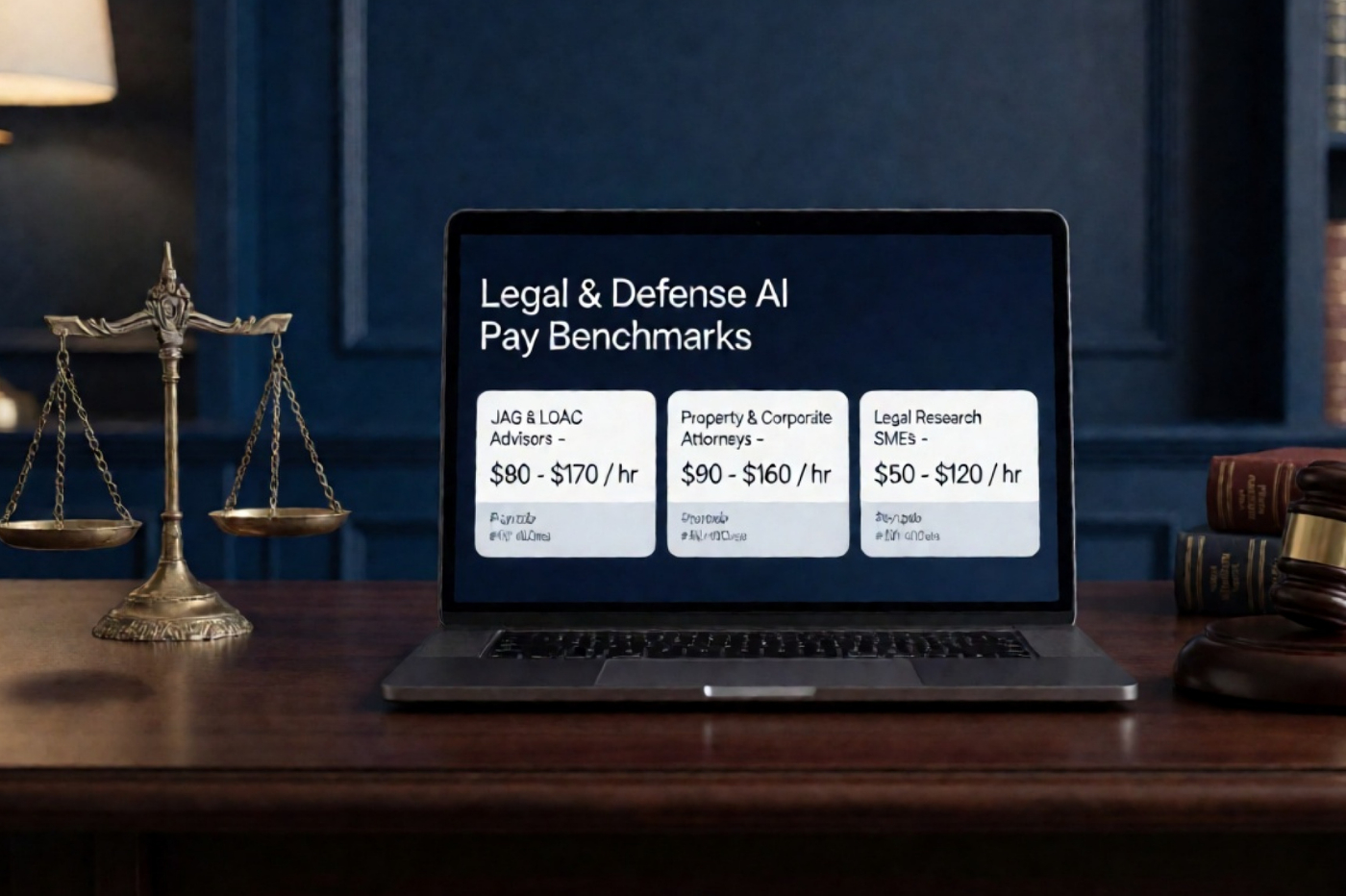
Legal & Defense AI Hourly Pay Breakdown
Opportunities in legal and military AI evaluation vary by legal specialization, bar admission, and domain expertise:

1. Military Legal Advisors & LOAC Specialists ($80–$170/hr)
Former Judge Advocate General (JAG) officers, military legal advisors, and defense SMEs train specialized defense models.
- Pay Rates: $80 to $170/hr.
- Primary Responsibilities: Evaluating AI outputs covering the Law of Armed Conflict (LOAC), rules of engagement (ROE), treaty compliance, international maritime law, and intelligence source handling.
2. Property, Corporate & Real Estate Law Specialists ($90–$160/hr)
Licensed attorneys specializing in commercial real estate, corporate transactions, and contract law.
- Pay Rates: $90 to $160/hr (with referral bonuses up to $350 on select platforms).
- Primary Responsibilities: Auditing automated contract reviews, verifying lease agreement interpretations, checking HOA compliance logic, and rating AI-generated legal motions.
3. Legal Research & Statutory Interpretation SMEs ($50–$120/hr)
Law graduates (JD), paralegals, and legal researchers.
- Pay Rates: $50 to $120/hr.
- Primary Responsibilities: Fact-checking case law citations, verifying statutory references against state and federal codes, and scoring Side-by-Side legal summaries.
Core Tasks in Remote Legal AI Evaluation
When working on legal AI projects, your daily work involves analyzing prompt outputs against established legal standards:
- Factuality & Citation Auditing: Checking whether court precedents, Supreme Court holdings, or statutory section numbers cited by the AI are accurate or hallucinated.
- Negative Constraint Handling: Testing whether an AI model properly respects negative prompts (such as "summarize this liability clause without offering formal legal advice").
- Red-Teaming High-Risk Legal Prompts: Stress-testing AI models with complex, multi-jurisdictional legal scenarios to identify logical errors or unsafe legal guidance.
Why Legal Professionals Choose Remote AI Contracting
- 100% Flexible & Self-Paced: Work around your primary practice, active service transitions, or personal schedule. Log in for 5 hours a week or 20+ hours a week.
- No Client Billing or Court Appearances: Avoid courtroom appearances, billable hour minimums, or client management. You work directly within cloud evaluation dashboards.
- Weekly Direct Payments: Earn reliable hourly compensation deposited directly into your bank account on weekly schedules.
Tips for Passing the Legal AI Vetting Assessment
- Detail Your Credentials: List your jurisdiction, bar admissions (if applicable), legal degrees (JD, LLM), or military operational background on your candidate profile.
- Prioritize Factuality Over Eloquence: In screening evaluations, penalize any AI output that sounds polished but cites non-existent case law or misinterprets statutory codes.
- Follow Rating Rubrics Closely: Ensure your written rationales clearly explain why one legal response is superior to another by referencing specific legal inaccuracies or formatting failures.
Ready to Apply Your Legal Expertise to Remote AI Roles?
Monetize your legal or military background with flexible, high-paying remote contracts.
👉 Click Here to Browse Verified Legal & Defense AI Roles & Download Free Guides
Explore active legal and defense positions across Micro1 and Turing, download our free 1-page Legal & Defense AI SME PDF Guide, and submit your application today!

About the author
Get AI Jobs From Home
Get AI Jobs From Home is a remote recruitment hub and curated directory dedicated to connecting work-from-home job seekers with verified AI contract opportunities. Covering everything from entry-level roles like data annotation and chatbot rating ($14–$45/hr) to specialized domain expert contracts in medicine, law, software engineering, and finance ($40–$285/hr), the platform provides transparent job listings alongside step-by-step test prep, screening walkthroughs, and rating rubrics for major platforms like Micro1 and Turing.